How Loud Is a Concert? Decibel Levels by Venue and Where You Stand
Most rock and pop concerts run at 100 to 110 dB, louder near the stage. Levels by venue type, safe times under NIOSH, and how to protect your ears.
110 dB on the decibel scale
Tap another sound to compare- Safe · under 65 dB
- Caution · 65–85 dB
- Risk · over 85 dB
A typical rock or pop concert is about 100 to 110 dB in the crowd. The front rows and the spots next to the speaker stacks are often louder, and the back of a large venue is usually a bit quieter. The US National Institute on Deafness and Other Communication Disorders (NIDCD) lists concerts at 94 to 110 dBA. At those levels, NIOSH guidance allows somewhere between a few minutes and an hour a day, which is why ringing ears after a show are so common.
How loud your concert is depends on the genre, the venue, the sound engineer and, most of all, where you stand.
How loud are different kinds of concerts?
These are typical ranges for the average level in the audience. Individual songs and peaks can run higher.
| Type of show | Typical level in the audience | Notes |
|---|---|---|
| Arena or stadium rock and pop | about 100 to 110 dB | Louder near the stage and speaker towers |
| Club gigs and small venues | about 100 to 110 dB | Small rooms leave little space to move away |
| Electronic music, festivals, nightclubs | about 100 to 110 dB, sometimes more | Heavy bass, long sets |
| Jazz, folk, acoustic sets | often about 80 to 95 dB | Depends heavily on amplification |
| Classical orchestra | often about 80 to 95 dB on average | Loud passages peak much higher, especially near brass and percussion |
For the full scale with everyday comparisons, see the decibel chart. The 110 dB page and the loudest sounds list show where a concert sits next to chainsaws, sirens and jet engines.
Why concerts are so loud
Amplified music is mixed to be felt as well as heard. Bass needs a lot of power to sound full, and a crowd of thousands adds its own noise. Our ears also adapt during a show: after half an hour, 105 dB starts to feel normal, and the sound often creeps up through the night. That adaptation is exactly why it is hard to judge levels by ear.
Does it matter where you stand?
A lot. Outdoors, sound from a single source drops by up to 6 dB each time you double your distance. Indoors, reflections from walls and ceilings reduce that effect, but position still matters.
| Where you are | What to expect |
|---|---|
| Front rows, barrier | Often the loudest part of the room, especially by the speakers |
| Directly in front of a speaker stack | Loud even at a distance; move off the line of the speakers |
| Middle of the floor, near the mixing desk | Often around 100 dB; usually the best-balanced sound |
| Back of the venue, seats in the upper tiers | Usually quieter, though reflections can keep levels high |
| Bars, corridors, outside areas | The best places for a break |
The mixing desk is a good reference point. The engineer is setting the sound for that spot, and many venues and festivals monitor the level there.
How long is it safe to listen?
NIOSH, the US agency for workplace health, recommends no more than 8 hours a day at 85 dBA, with the safe time halving for every 3 dB increase. OSHA’s legal workplace limit is less strict, but it still applies to the people working at the venue.
| Concert level | NIOSH safe time per day | OSHA workplace limit | A 2-hour show at this level |
|---|---|---|---|
| 95 dB | about 47 min | 4 h | about 2.5 times the safe dose |
| 100 dB | 15 min | 2 h | 8 times the safe dose |
| 105 dB | about 5 min | 1 h | about 25 times the safe dose |
| 110 dB | about 1.5 min | 30 min | about 80 times the safe dose |
These limits were designed for workers exposed day after day. A single concert does not mean certain damage, but it uses far more than a day’s safe allowance. The risk builds with every loud night, and noise-induced hearing loss does not heal.
If your ears ring or sound muffled afterwards, the show was too loud for the time you spent there. Our guide to ringing in the ears after a concert explains what is normal and when to see a doctor or audiologist.
Are there rules for how loud a concert can be?
In most places, there is no legal limit on how loud a concert can be for the audience. Rules usually focus on noise reaching neighbors or on the people who work at the venue.
- WHO guidance. The World Health Organization’s global standard for safe listening venues and events recommends keeping sound at or below 100 dB averaged over 15 minutes, monitoring levels live, and offering free hearing protection and quiet zones. It is voluntary guidance for venues and governments.
- Some countries set audience limits. Switzerland, for example, caps most amplified events at 100 dB(A) averaged over an hour, with earplugs and warnings required at higher-level events.
- Workers are covered. Staff, security and musicians fall under workplace rules such as OSHA in the US or the Control of Noise at Work Regulations in the UK. Our OSHA noise standard guide explains the US rules.
- Neighbors. Outdoor events usually have to meet local noise limits at nearby homes and curfews set in their permits.
How to enjoy a concert without hurting your ears
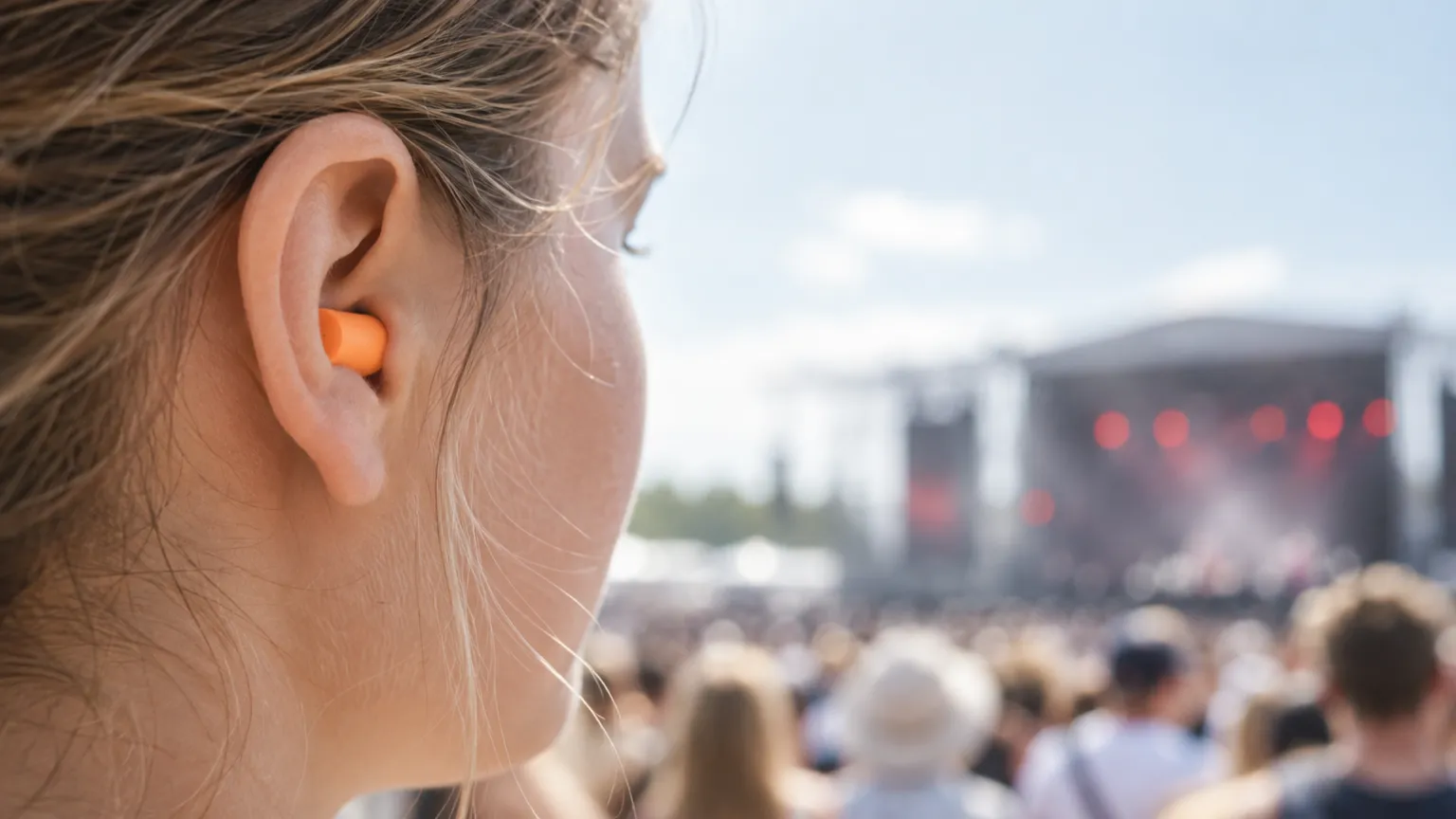
- Wear earplugs. Foam earplugs cut roughly 15 to 30 dB when inserted properly. Musicians’ earplugs with flat filters, often 10 to 25 dB, keep the music clear. A 105 dB show through 20 dB of protection is about 85 dB at your eardrum.
- Stand back and off the speaker line. Move away from the front and the speaker stacks. The middle of the floor is often the best balance of sound and safety.
- Take breaks. Step out for a few minutes between sets. Quiet time helps your ears and lowers the total dose.
- Be careful at festivals. Several days in a row give your ears no recovery time. Protect them every day, not just the headline night.
- Protect children. Children need ear defenders sized for them at any amplified show. ASHA’s guidance on recreational noise covers concerts and other loud leisure activities.
- Check the level. A quick reading tells you whether you are at 95 dB or 110 dB, which is the difference between about 47 minutes and about 1.5 minutes of safe time.
Can you measure a concert with your phone?
Yes, roughly. Hold the phone at about head height, away from your body, and record for a whole song or set rather than glancing at the number. The average (Leq) for the set is the figure that matters for hearing.
Phone microphones have limits. They are built for speech and often clip somewhere between 100 and 120 dB, so readings near the stage may be lower than the real level. Our iPhone measuring guide covers accuracy and placement. Apple Watch users can also turn on noise notifications to get an alert when a venue is loud.
Measuring your next concert
Decibel Meter: dB Sound Level for iPhone and Apple Watch shows the live level, records the average (Leq), maximum and peak for the whole show, and calculates a NIOSH or OSHA noise dose so you can see how much of a safe day you have used. Camera mode overlays the reading on a video clip of the stage (saved without sound, because the microphone stays dedicated to measuring). The app is free to download, and live measuring is part of the subscription. See what the app does, or check a room quickly with the free online meter in your browser.
Questions
How many decibels is a concert?
Most amplified rock, pop and electronic concerts average about 100 to 110 dB in the audience, with peaks higher near the stage. NIDCD puts concerts at 94 to 110 dBA. Classical and acoustic concerts are usually quieter on average.
Is 100 dB at a concert safe?
Only for a short time. NIOSH recommends no more than 15 minutes a day at 100 dB, so a two-hour show at that level is about eight times the safe daily dose. Earplugs that lower the level by 15 to 20 dB bring it into a much safer range.
Where is the quietest place to stand at a concert?
Away from the speaker stacks and out of their direct line. The area near the mixing desk, usually in the middle of the floor, is often quieter than the front and is where the sound is balanced best.
Do earplugs ruin the sound at a concert?
Foam earplugs muffle high frequencies, so music can sound dull. Musicians' earplugs with flat-response filters lower the level more evenly, often by 10 to 25 dB, so the music still sounds clear, only quieter.
Can my phone measure how loud a concert is?
Roughly. Phone microphones often clip somewhere between 100 and 120 dB, so readings near the stage may be too low. Away from the speakers, a phone gives a useful picture of the average level over a set.