How Loud Are Fireworks? Decibels, Safe Distance and Hearing Protection
Fireworks reach 140 to 160 dB up close, past the 140 dB peak limit NIOSH and OSHA set for adults. Safe distances and hearing protection for kids and pets.
140 dB on the decibel scale
Tap another sound to compare- Safe · under 65 dB
- Caution · 65–85 dB
- Risk · over 85 dB
Fireworks are among the loudest sounds most people ever hear. Up close, a firecracker or a consumer rocket peaks at around 140 to 150 dB, and the US National Institute on Deafness and Other Communication Disorders (NIDCD) puts a fireworks show at 140 to 160 dB near the source. That is louder than a jackhammer, a jet taking off or a rock concert, and it is above the 140 dB peak limit that NIOSH and OSHA use for unprotected adult ears.
The good news is that the level falls quickly with distance. Watching a public display from the back of the crowd is very different from lighting rockets in your own garden.
How loud are different kinds of fireworks?
| Source | Typical level | Where the figure comes from |
|---|---|---|
| Firecracker or banger at about 1 m (3 ft) | about 150 dB peak | ASHA |
| Fireworks show, near the source | 140 to 160 dB | NIDCD |
| Gunshot, for comparison | about 140 dB peak and up | ASHA |
| Rock concert near the speakers | about 110 dB | NIDCD lists concerts at 94 to 110 dBA |
| Thunder overhead | about 120 dB | 120 dB |
Fireworks are impulse noise: a very short, very sharp bang. They are measured as a peak level, not an average. A single bang at 150 dB peak lasts a fraction of a second, but at that level duration matters far less than it does with steady noise. A short enough blast can still damage the inner ear.
For the wider picture, the loudest sounds list ranks fireworks next to gunshots and jet engines, and the 140 dB page explains what happens at that level.
Can fireworks damage your hearing?
Yes. Hearing guidance treats impulse noise above 140 dB peak as unsafe for any length of time.
- OSHA, the US workplace safety agency, says exposure to impulse noise should not exceed 140 dB peak.
- NIOSH uses the same 140 dB peak ceiling in its recommended limit.
- The WHO Guidelines for Community Noise (1999) set a lower peak limit for children: 120 dB.
- ASHA, the American Speech-Language-Hearing Association, lists fireworks at 3 feet at about 150 dB and describes that range as not safe for any period of time.
The usual signs that a display was too loud for you are ringing in the ears (tinnitus) or muffled hearing afterwards. These often fade within hours to a day or two, the same as after a concert. If they do not, or if you notice sudden hearing loss in one ear, see a doctor or audiologist. Our guide to ringing in the ears after a concert covers the warning signs in more detail.
How far away should you stand from fireworks?
Outdoors, sound from a single point loses about 6 dB every time you double your distance. That gives a rough idea of how quickly a 150 dB bang drops off.
| Distance from the bang | Rough peak level |
|---|---|
| 1 m (3 ft) | 150 dB |
| 4 m (13 ft) | 138 dB |
| 16 m (52 ft) | 126 dB |
| 64 m (210 ft) | 114 dB |
| 256 m (840 ft) | 102 dB |
These are estimates based on the inverse-square law on open ground, starting from the ASHA figure. Real levels vary with the size of the firework, wind, buildings that reflect sound, and whether the bang happens at ground level or high in the air. Large display shells are much more powerful than consumer fireworks, which is why public shows keep the crowd far back.
What the table shows is that the riskiest place is close to the launch point. The person lighting garden fireworks, and anyone standing next to them, gets the full blast.
Who needs extra care?
Babies and young children
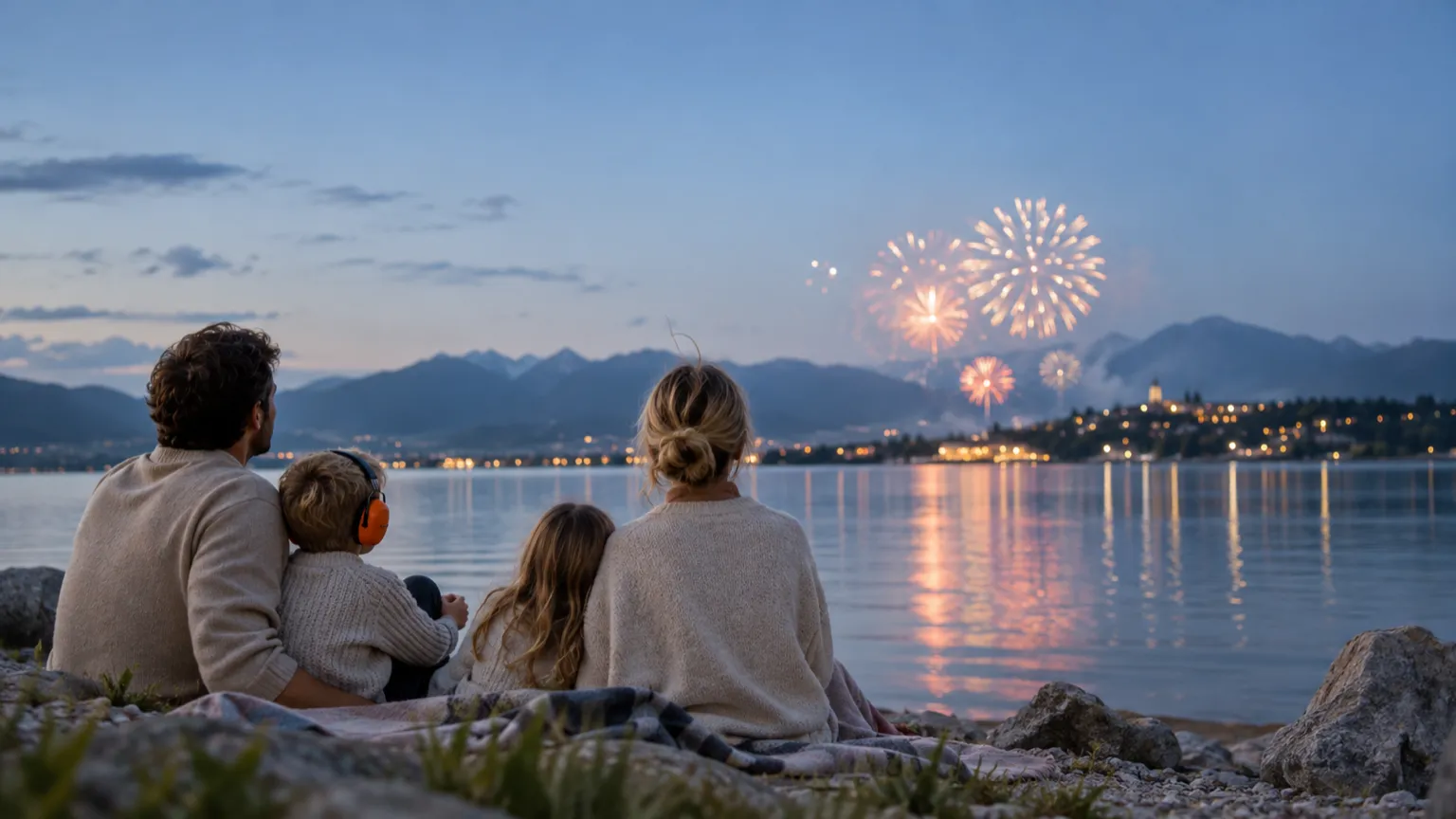
Children’s ears are more sensitive, and small children cannot tell you a sound hurts until it already has. The WHO’s 120 dB peak limit for children is 20 dB lower than the adult limit, which in practice means standing roughly ten times further away from the same bang.
- Watch from far back, from a window or from a car with the windows up.
- Use ear defenders sized for children. Earmuffs fit small ears more reliably than foam plugs.
- Babies are best kept away from fireworks displays entirely.
- Keep children well away from bangers and firecrackers, which are loud at close range as well as a burn risk.
Pets
Many dogs and cats find fireworks frightening. Keeping pets indoors, closing curtains and windows, and giving them a quiet room with familiar bedding are common steps. If your pet is very distressed by fireworks every year, a vet can advise.
People with tinnitus or sensitive hearing
If you already have tinnitus, hyperacusis or hearing loss, loud bangs can make symptoms worse for a while. Plan to watch from further away and wear protection.
What hearing protection works for fireworks?
- Foam earplugs. Cheap and effective when rolled and inserted properly. They typically lower the level by 15 to 30 dB.
- Earmuffs. Easy to put on and take off, good for children and for people lighting fireworks.
- Both together for the person setting off a large number of fireworks at close range.
- Covering your ears with your hands is better than nothing in an emergency, but it is not reliable protection.
A 20 dB reduction turns a 150 dB peak at close range into about 130 dB. That still is not a safe distance to stand at, which is why distance and protection work best together.
When are fireworks loudest in the year?
In the US, the Fourth of July and New Year’s Eve are the big nights. In the UK, Bonfire Night on 5 November is the peak, with fireworks often running for several evenings either side. Diwali, Lunar New Year and many national holidays also bring fireworks. If you live near a regular display site, it is worth having earplugs and ear defenders ready before the season starts.
Local rules on when consumer fireworks can be used vary a lot by country, state and city, and many places limit late-night use. Check your local council or city rules before planning a garden display.
Can you measure fireworks with a phone?
Only roughly. Phone microphones are built for speech and usually clip somewhere between 100 and 120 dB, depending on the model. Near a firework the true peak is far above that, so the phone will read low. From a distance, a phone is still useful for comparing spots: you can see whether moving back 50 metres takes the readings down by a few decibels or a lot. For accurate peak measurements close to the launch site, you need a professional meter rated for high levels.
Checking the noise level
Decibel Meter: dB Sound Level for iPhone and Apple Watch shows the live level and records maximum and peak values, so you can compare viewing spots at a display and see how a night of fireworks adds up. Keep the microphone limit in mind: readings close to the launch site will be lower than the real peak. The app is free to download, and live measuring is part of the subscription. See what the app does, or try the free online meter in your browser for a quick check, and use the decibel chart to compare what you hear.
Questions
How many decibels is a firework?
A firecracker or consumer firework at close range peaks at around 140 to 150 dB, and NIDCD lists fireworks shows at 140 to 160 dB near the source. From the crowd at a public display the peaks are lower, but often still well above 100 dB.
Can fireworks damage your hearing?
Yes. A single blast above 140 dB peak can cause lasting damage, which is why NIOSH and OSHA set 140 dB as the peak limit for unprotected adults. Ringing ears or muffled hearing after a display are signs the exposure was too loud.
How far away should you stand from fireworks?
As far back as the event allows. Every doubling of distance lowers the level by about 6 dB outdoors. For home fireworks, keep at least the distance printed on the packaging and add ear protection if you are the one lighting them.
Are fireworks safe for babies and young children?
Their ears are more vulnerable, so it is best to watch from far away or indoors, and to use ear defenders sized for children. The WHO's community noise guidelines advise that children should not be exposed to peaks above 120 dB.
Can a phone measure how loud fireworks are?
Only roughly. Phone microphones usually clip somewhere between 100 and 120 dB, so close-range bangs read lower than they really are. A phone is useful from a distance to compare spots, not to measure peaks next to the launch site.